
This project conducted research and analyzed the data for Project Semicolon in order to suggest a way to improve their organization.

Final Report
Brooke Rullman, Marissa Wanger, Gab Figliozzi, Grant Skophammer, Jeremy Troetti
Table Of Contents
Executive Summary…………….3
Background Research…………..4-5
Qualitative Method………………………….6
Qualitative Results………………………….7
Quantitative Method………………………….8
Quantitative Results………………………….9
Conclusion………………….….10-11
References……………………..12
Appendices
Appendix A…………….13
Appendix B…………….14-16
Appendix C…………….17-21
Appendix D…………….22
Appendix E…………….23
Appendix F…………….24-27
Appendix G…………….28-30
Executive Summary
Throughout this project, our group conducted various methods of research, both qualitative and quantitative, to find ways that your organization can increase their presence on campus. To start, we first conducted qualitative research, beginning with our research question: What are college students’ understanding of their access to mental health resources? Through this question, we gained a better understanding of how knowledgeable students are regarding the mental health resources that are available to them on and off campus. The results served to help us determine that students on a college campuses would be the right market for Project Semicolon.
To conduct the actual research, the method that we utilized was a series of one-on-one interviews with fellow Quinnipiac students. Prior to the interview as a group, we compiled a list of 18 questions that would show our subjects thoughts on general mental health concepts. It was comprised of a variety of questions that tested each participants knowledge on mental health and how they felt about such an anomaly.
After analyzing our findings from our qualitative research, our group conducted quantitative methods to further our understanding of how to increase Quinnipiac’s students consciousness of your organization on campus. To do this, the method we chose was to send out a survey in the Quinnipiac class groups on Facebook and other organizations on campus. Our research question for this was: Does Quinnipiac help you find other resources off campus for mental health concerns? Through this question, we determined what Quinnipiac students knew they could do to address their mental health concerns, outside of utilizing the resources available at the student health center located on campus.
Our findings in the survey showed that participants thought that the university should make students more aware of mental health resources on and off campus. We determined that this can serve as an opening for Project Semicolon to work its way onto campus by teaming up with the student health center.
Through analyzing both the qualitative and quantitative research we conducted, we feel that Project Semicolon has a clear opening to a target market in Quinnipiac students. Because of this, Project Semicolon can also expand to other universities as well, considering mental health is a problem that impacts a significant amount of college students.
Background
Mental illness today more than ever has become a crisis consuming college students, many of whom face high levels of stress and anxiety. Efforts toward awareness have also become extremely relevant while trying to handle the problem. Project Semicolon is an awareness organization dedicated to preventing suicide and educating communities of this issue. “Our work is based on the foundation and belief that suicide is preventable and everyone has a role to play in preventing suicide” (Project Semicolon). The organization began in 2013 and chose the semicolon because an author can chose whether or not to end a sentence, much like one can do with a life.
College students’ mental health is impacted greatly over their four years of college, which can be very stressful for many. “Over one-third (37%) of students with a mental health condition age 14–21 and older who are served by special education drop out—the highest dropout rate of any disability group” (NAMI). Whether a student is facing a problem at home, at school, or are just battling with their own mental state, they are often unaware of the help at school or even outside of school that they can utilize.
Fifty percent of college students say that their anxiety derives from school related stress (Anxiety and Depression Association of America). Through Project Semicolon’s work in educating people on the topic of mental health and providing resources to those who are struggling, we were able to use that information further our survey questions. Our group began our interest when we found that you offer a mental health screening online as well as finding treatment, sharing stories with those who can relate, and help with coping with trauma. While we were familiar with Project Semicolon, we wanted to find out if students are aware or not of your organization and how helpful it is. Students continue to struggle all over the country, even when they know there are resources for help available to them on campuses. The question we want to find out is: Why is this still the case? Would off campus help be more substantial to them? To find this relationship, you would need a large group of students who have utilized both on and off campus groups and services and compare their experiences.
Qualitative Research
Method:
In our Qualitative report our research question was, “what are college students’ understanding of their access to mental health resources?” This question helped your organization understand how many students know anything about mental health and if they actually know what’s going on around their campus.
Sampling Strategy
Our team used one on one interviews for our qualitative research. We conducted ten interviews. A significant part of our research was choosing the one on one interviews because of the privacy. We hoped that people would feel more comfortable talking to a peer or a friend. The one on one interview provided a safe, and comfortable setting to discuss a somewhat uncomfortable topic. To secure the participants and make sure they knew their information would remain anonymous, we had a participants sign a consent form (Appendix A). Each interview was conducted in quiet and private spaces so the interviewee could concentrate and not feel pressured by anyone else being around.
Recruitment Procedure
Our procedure for conducting the interviews started with asking if each interviewee would be interested in being interviewed. We found our interviewees through convenience of peers in classes or friends who lived with/or near us. If the interviewee agreed, then we set up a time and place for each interview to be held. Before the interview started, we gave them the consent form and if they didn’t have any questions, we began the interview. Each interview consisted of eighteen open ended questions (Appendix B)that we recorded.
Results
In the information we obtained in answering the question “what are your understandings of access to mental health resources?,” many knew some resources that advocate for mental health awareness, but did not know how to get help through them. We asked, “Have you heard of Project Semicolon? If so where have you seen it? If so, how often have you seen it?” Two participants out of ten had heard of it, but didn’t know how to get help through it. Another participant had heard of the organization, and even had the semicolon tattoo, but did not know how to directly get help from your organization itself. Three participants had not heard of Project Semicolon previously. The last four participants had never heard of organizations that are used as mental health resources. The only resource that they knew about was counseling through the school. In the information we obtained, we found many similarities between our interview transcripts. Many interviewees didn’t know what organizations to use to get help, and if they did know what organizations promote mental health awareness and help, the interviewees didn’t know how to use those resources. Although many were unaware about Project Semicolon or health organizations in general, every interviewee knew at least one celebrity that struggled with a mental illness. That’s extremely important in the finding we obtained. Students are hyper aware of what is happening in popular culture and the best way to get a message out to a large number of college students would be through internet promotion on campus. On an even larger scale, celebrities could influence Project Semicolon even more.
Survey Research
Method
In our quantitative research, we posed the question of, “do colleges help their students find mental health resources off campus?”. This question was general and not too specific to Quinnipiac University. Our findings from our university could help better what your organization can do for schools with a similar demographic to Quinnipiac University.
Sampling Strategy
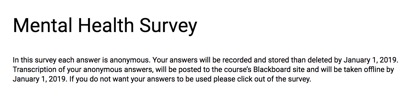
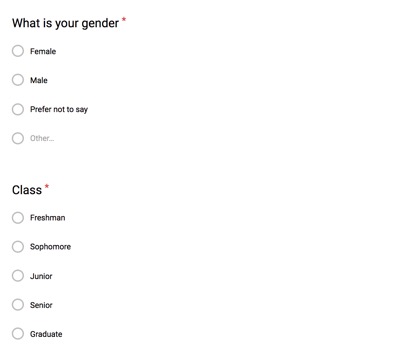
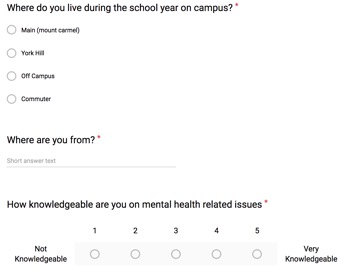
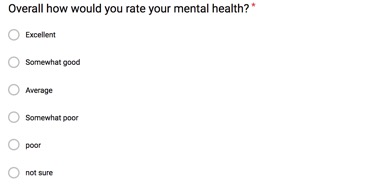
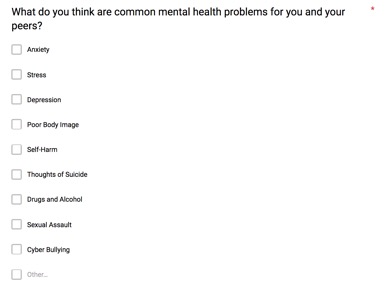
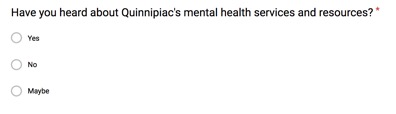
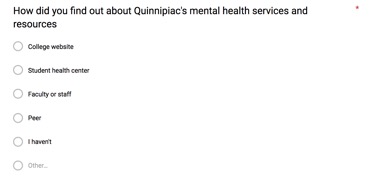
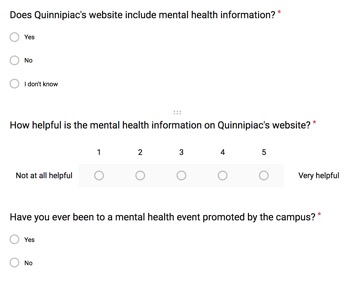
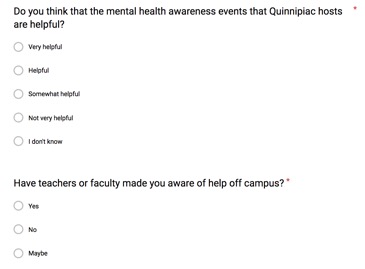
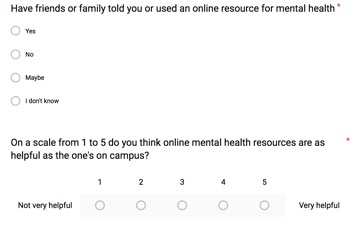
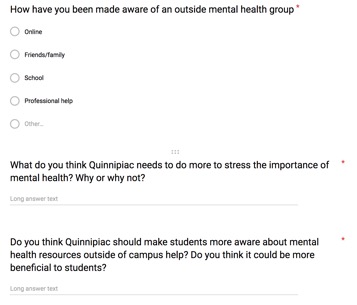
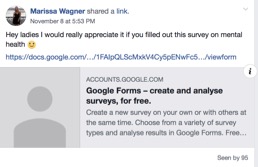
Our group created a survey to collect data for our quantitative research. This survey consisted of 19 questions for participants to answers (Appendix C). Participants could find the survey online in a cross sectional analytic online survey. We recruited participants through Facebook groups pages, including all Quinnipiac class pages as well as other Quinnipiac University organization’s pages (Appendix D). The survey also consisted of two open ended questions where participants could share their own opinions .
Recruitment Procedure
A majority of students have a Facebook account, so we believed that this would be a more effective way to recruit participants. All participants of the survey were undergraduate students from Quinnipiac University. It was important for us to stress that the survey would give participants anonymity. When participants have to reveal their identity, it can discourage them from participating in a survey (Appendix E). In our consent explanation at the beginning of the survey, participants were made aware that if they were uncomfortable with the topic or questions being asked that they could exit the survey at any time. Because of the time frame we had to collect and analyze the data, we had our survey available for participants to take from November 8, 2018 to November 13, 2018.
Results
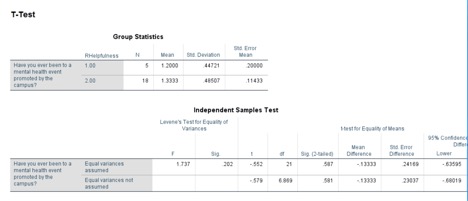
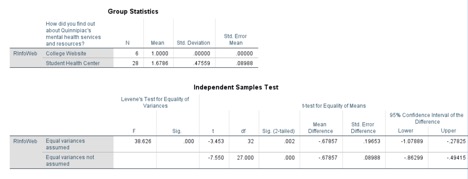
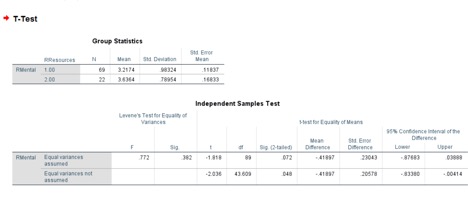
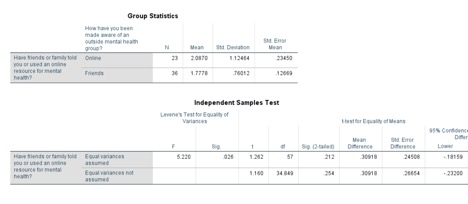
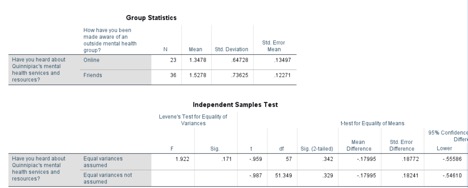
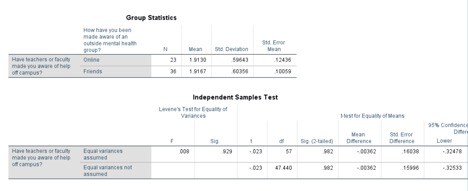
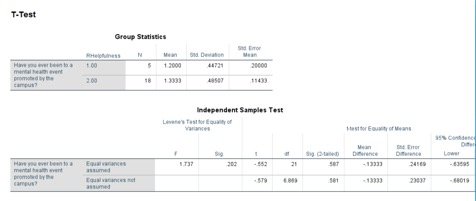
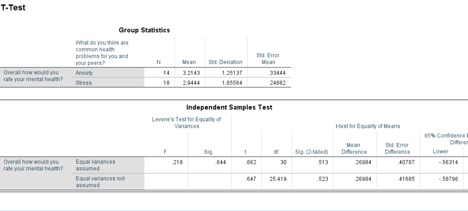
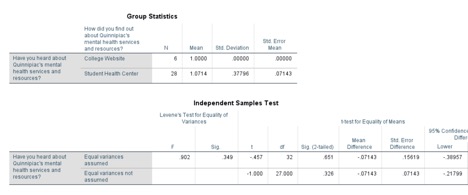
To make sense of the data that we collected from our survey, we used the program SPSS to run t-tests (Appendix F). The first set of variables (Appendix G) that we tested were mentalstatus and resources to look at the relationship between the status of student’s mental health and the mental health resources Quinnipiac provides its students. The result that this test showed the questions were approaching significance. (M=3.22, SD=.98) (M=3.64, SD=.17) t(89)=-1.82, p=.07. The next two variables that we tested were event and helpfulness to look at the relationship between the mental health events Quinnipiac provides and what students think of them. This was not significant. Even though it was not significant, it is important to understand the people who are going to these events, and if they are getting anything out of it t(21)= -.55, p= .59. The third test we ran was for the variables, findresources and infoweb. We found it to be very significant, and most students are not aware if Quinnipiac has information about mental health on their website in relation most people who have heard about the mental health services on campus have heard it from the Health Center itself. (M=1.68, SD=.48), t(-3.45), p=.002 . The last variables we tested were infoteacher and awareness to see the relationship between the information that professors provide to students about mental health resources and the awareness that it gives to students. The relationship was approaching significance (M=1.92, SD= .604), t(-.023), p= .982
Conclusion & Key Takeaways
Through our research, we came across a few key takeaways that Project Semicolon could benefit from. The information we gained about college students, their mental health status, and their decision to receive help are all things that could guide your organization’s efforts to reach more people. The value in our research is that we were able to find quick, yet important information about a specific university that could also become the basis for further research around the world.
One takeaway we had was in regard to the status of Quinnipiac students and their knowledge of resources on campus. With an approaching significant relationship, we can understand that many students who are aware of their lower mental health status are also aware of the resources they can take advantage of. However, not every person who is struggling is feeling the same way, which means there is a potential need for other sources of help. Again, this is only an approaching significant relationship, so further research would be needed to determine the true significance of these variables.
Another takeaway has to do with the significant relationship between students who are aware of campus resources and their lack of knowledge of online information through the school. If students who are seeking help can’t find resources through the school online, then there is a need for Project Semicolon to be their online resource.
The third key takeaway was the relationship between events and their helpfulness that they provide to students. The relationship was not significant, but this is important to know because then your organization can create better ways to engage students in mental health events on campus.
Our recommendations are based on the idea of appealing to college students that aren’t satisfied by the resources that are provided to them through the school. A major opportunity we see for you is to partner with schools to provide education and resources for students. Mainly, there is a need for an online resource that students aren’t getting. Becoming an online source that schools introduce to students as an outside opportunity, it will both promote awareness for an easy online access, but it may also create a more approachable figure, as it is not directly facilitated through the school. Our research has shown that a major way students find out about the resources available to them is either peers or professors. With that in mind, if Project Semicolon were to sit down with professors they could explain to them how to become a gatekeeper of information. This will greatly help raise awareness for the online component. Expanding on the partnership, there is potential for face-to-face interaction. Your organization could tour schools with speakers to share stories, educate students on mental health, and introduce Project Semicolon as a major resource. This may help to create a more meaningful event experience for students.
Another recommendation we have is to get more involved on social media. Currently, your Instagram posts about once a month. We feel there is much room for improvement. Project Semicolon’s pages could be extremely successful due to the engaging nature of your organization. It could be a source of inspiration and motivation for those who are struggling. It could be a place to become informed and educated on the topic. Most importantly, it could be an engaging way to share stories and have people interacting with your organization. This recommendation is based on the data we have gained about the need for easier online resources for students.
Overall, we see many valuable opportunities for your organization to continue to provide meaningful support for people struggling with mental illnesses. Our research suggests a need for you to grow an online following and consider the idea of also becoming a physical presence.
References
A. (2015). Mental Health and College Students. Retrieved December 3, 2018, from https://adaa.org/finding-help/helping-others/college-students/facts
P. (2017). Coping After Trauma. Retrieved December 3, 2018, from https://projectsemicolon.com/coping-after-trauma/
“NAMI: National Alliance on Mental Illness.” NAMI: National Alliance on Mental Illness, http://www.nami.org/.
Appendix A:
You are invited to participate in a study related to mental health awareness. The outcomes of the study will be limited to a class paper. The study will take 20-30 minutes of your time. Your name will never be used in any outcome of this study. All your responses will be anonymous. There are no known risks for you in this study. The benefits include an opportunity to reflect on an important public health topic.
If you agree to participate, you will be interviewed in one session. The data from your interview will be analyzed along with 9 other responses. The interview will be [AUDIO] recorded and stored on the [10/22] and deleted by January 1, 2019. Transcription of your interview, without any of your identifying information, will be posted to the course’s Blackboard site and will be taken offline by January 1, 2019.
If you decide to participate, you are free to withdraw your consent and to discontinue participation at any point without any penalty. If you have questions, you may contact the researcher (researcher’s email or phone number).
Participant’s Agreement:
I have read and understand the information provided above, and have been offered a copy of this information statement and consent form to keep. I have asked all the questions I have at this time. I voluntarily agree to participate in this research study.
_____________________________________________ Signature of Participant
_____________________________________________ Name of Participant
_____________________________________________ Signature of Investigator Obtaining Consent
_____________________________________________ Printed Name of Investigator
______________________ Date Printed
______________________ Date
Appendix B:
- What does mental health mean you?
- What are mental illnesses to you?
- Have you or anyone you’ve known
struggled with thoughts of suicide or depression?
- If so how did that person deal with it?
- What are ways people mistreat their mental illness(es)?
- Do you know any warning signs
of mental illnesses?
- If they say no say: anxiety, apathy, general discontent, guilt, hopelessness, loss of interest, loss of interest or pleasure in activities, mood swings, or sadness. Hard time sleeping. Excessive hunger, fatigue, loss of appetite, or restlessness. Behavioral: agitation, excessive crying, irritability, or social isolation. Cognitive: lack of concentration, slowness in activity, or thoughts of suicide. Weight: weight gain or weight loss
- If they say yes, ask them to explain.
- Have you heard of any
celebrities struggling with thoughts of suicide or depression? If you said
yes, who?
- And what do you know about their struggle?
- Do you know of anyone that has
been too afraid to open up on their mental illness because of their family
values?
- Were there any ways that they dealt with their mental illness?
- Are you familiar with any organizations that stress the importance of mental health awareness?
- Do you know what resources for mental health are available on campus?
- Do you think faculty and staff help make you aware of what is available to you? Explain yes or no.
- Have you seen anything for mental
health awareness advertised on campus?
- Where have you seen anything for mental health awareness advertised on campus?
- And what did you see?
- Have you ever been afraid to speak up to get help for yourself or someone else?
- Have you heard of Project Semicolon? If so where have you seen it? If so, how often have you seen it?
Project Semicolon is an organization dedicated to the prevention of suicide. The goal is to raise awareness, educate communities, and provide tools to those who struggle in order to save lives. It is a nonprofit organization working on the international, national, state and local levels.
It works through various levels. One way to get information and receive help is through their website. There you can find coping techniques and resources specific to a given mental disorder. There are always ways to get physically involved, and hardgood products to help support the cause and raise awareness.
- If you or someone you know have interacted with Project Semicolon, how?
- If needed, would you know how to seek help using Project Semicolon?
- Have you or someone you know benefitted from utilizing an awareness group like this?
- Do you think you would be more comfortable talking to someone
close to you or a stranger?
- Why?
- Do you know what to do for
somebody who is struggling from such illness?
- What was the experience that person had and was it successful?
Appendix C:
Appendix D: Quantitative Recruitment Materials
Appendix E: Consent Form
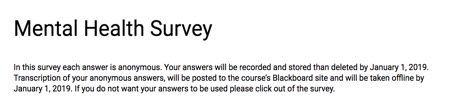
“In this survey each answer is anonymous. Your answers will
be recorded and stored than deleted by January 1, 2019. Transcription of your
anonymous answers, will be posted to the course’s Blackboard site and will be
taken offline by January 1, 2019. If you do not want your answers to be used
please click out of the survey.”
Appendix F: SPSS Results
Appendix G: Cheat Sheet
| Question in survey | Response Options | Variable Name |
| Overall how would rate your mental health? | Excellent – 1 Somewhat Good – 2 Average – 3 Somewhat Poor – 4 Poor – 5 Not Sure – 6 Other – 7 | MentalStatus |
| Have you heard about Quinnipiac’s mental health services and resources? | Yes – 1 No – 2 Maybe – 3 | Resources |
| How did you find out about Quinnipiac’s mental health services and resources | College website – 1 Student health center – 2 Faculty or staff – 3 Peer – 4 I haven’t – 5 Other – 6 | FindResources |
| Does Quinnipiac’s website include mental health information? | Yes – 1 No – 2 I don’t know – 3 | InfoWeb |
| Have you ever been to a mental health event promoted by the campus? | Yes – 1 No – 2 | Event |
| Do you think that the mental health awareness events that Quinnipiac hosts are helpful? | Very helpful – 1 Helpful – 2 Somewhat helpful –3 Not very helpful – 4 I don’t know – 5 | Helpfulness |
| Have teachers or faculty made you aware of help off campus? | Yes – 1 No – 2 Maybe – 3 | InfoTeacher |
| Have friends or family told you or used an online resource for mental health | Yes – 1 No – 2 Maybe – 3 I don’t know – 4 | FamilyResource |
| How have you been made aware of an outside mental health group | Online – 1 Friends – 2 Family – 2 School – 3 Professional Help – 4 Other – 5 | Awareness |
| What do you think are common mental health problems for you and your peers? | Anxiety – 1 Stress – 2 Depression – 3 Poor Body Image – 4 Self Harm – 5 Thoughts of Suicide – 6 Drugs & Alcohol – 7 Sexual Assault – 8 Cyber Bullying – 9 | Problems |
 Grant Skophammer